Think positive ! Stay motivated ! Transform your life !

Exploring the Wisdom of Lao Tzu: Founder of Taoism
Mamuni Digal
6/11/20257 min read


Lao Tzu, a central figure in Chinese philosophy, is best known for his foundational role in Taoism and as the reputed author of the seminal text, the Tao Te Ching. Traditionally believed to have lived during the Eastern Zhou Dynasty in the 6th century BCE, his life is shrouded in legend, making it difficult to establish concrete biographical details. His name, which translates to "Old Master," signifies both the depth of wisdom he is thought to possess and his revered status within philosophical circles.
The historical context during which Lao Tzu lived was characterised by political instability and social upheaval, with various feudal states vying for power. It was a period that sparked profound interest in philosophical inquiry and the search for effective governance. As a contemporary of Confucius, Lao Tzu likely engaged with the emerging ideas of morality, ethics, and the nature of human existence. However, unlike Confucius, whose teachings emphasised order and societal roles, Lao Tzu advocated for simplicity, humility, and living in harmony with the natural world. These ideas are encapsulated in the Tao Te Ching.
The influence of Lao Tzu's philosophy extends far beyond his own time, shaping not only spiritual and religious perspectives within China but also impacting global philosophical thought. His teachings emphasise the concept of 'Dao,' which can be interpreted as the natural way or the underlying principle of the universe. Lao Tzu's legacy is evident in diverse fields, including religion, ethics, leadership, and psychology, fostering a perspective that values balance, moderation, and an understanding of life's ever-changing nature.
As such, Lao Tzu stands not merely as a historical figure but as a symbol of wisdom whose ideas continue to resonate, encouraging individuals to seek a life in accordance with the harmonious principles of the Dao.
The philosophical framework of Taoism, as articulated by Lao Tzu, revolves around several core principles that seek to guide individuals towards a harmonious existence. Central to these teachings is the concept of 'Tao', often translated as 'the Way'. The Tao represents the fundamental order of the universe, a path that, when followed, leads to a serene and balanced life. This idea encourages adherents to align their actions with the natural flow of the world, recognising the interconnectedness of all things.
Another significant principle is 'Wu Wei', or non-action. It is crucial to clarify that this does not promote inaction but rather suggests a state of effortless action. In essence, Wu Wei encourages individuals to move through life without force, allowing experiences to unfold naturally. This philosophy fosters resilience and adaptability, providing a framework through which one can respond to challenges with grace and ease.
Simplicity is yet another key tenet of Taoism. Lao Tzu advocates for an uncomplicated life, emphasising the importance of minimalism and de-cluttering both in physical possessions and mental distractions. Simplifying one’s life can lead to profound contentment, as individuals can focus on what truly matters, thus eliminating unnecessary stress.
Taoism places great significance on harmony with nature. This principle emphasises the need to live in accordance with the natural rhythms of the environment. Appreciating the beauty of nature and understanding our place within it encourages respect for the world around us. By embodying these core philosophies, individuals can cultivate a balanced existence, bridging ancient wisdom with contemporary practices.
Lao Tzu’s teachings emphasise the value of simplicity, humility, and alignment with the natural flow of life. To incorporate these principles into daily routines, one can start by embracing simplicity in both thoughts and actions. In a world filled with complexities, simplifying one’s life can lead to greater clarity and peace. This can be achieved by decluttering physical spaces, reducing the number of commitments, and prioritising what truly matters. By focusing on essential tasks and letting go of what is non-essential, individuals can create a more tranquil living and working environment.
Practising humility is another essential aspect of Lao Tzu’s philosophy. Humility promotes an understanding that one does not have all the answers and that wisdom can come from any source. This can be applied by actively listening to others, being open to different perspectives, and recognising the limits of one’s knowledge. This approach not only fosters better relationships but also encourages personal growth, enabling individuals to learn from experiences rather than merely seeking to impose their views on others.
Finding peace through alignment with nature is a cornerstone of Taoism. To achieve this, individuals can incorporate practices such as mindfulness meditation, which reinforces a connection with the present moment. Nature walks also serve as an excellent means to reconnect with the natural flow of life, allowing individuals to appreciate their surroundings and the simplicity inherent in nature. Engaging in these practices helps cultivate tranquillity and reduce stress, qualities that are often overlooked in today’s fast-paced society. Ultimately, by applying these teachings of Lao Tzu, one can foster a more harmonious and enriching life, overcoming the turbulent demands of modern existence.
Famous Quotes For Daily Inspiration By Lao Tzu
" The journey of a thousand miles begins with a single step.
" Knowing others is intelligence; knowing yourself is true wisdom. Mastering others is strength; mastering yourself is true power.
" Those who know do not speak. Those who speak do not know."
" When you are content to be simply yourself and don't compare or compete, everyone will respect you."
" The truth is not always beautiful, nor beautiful words the truth.
" Being deeply loved by someone gives you strength, while loving someone deeply gives you courage."
" Care about what other people think and you will always be their prisoner."
" Be content with what you have, rejoice in the way things are. When you realize there is nothing lacking, the whole world belongs to you."
" A man with outward courage dare to die, a man with inner courage dares to live."
" If you are depressed you are living in the past. If you are anxious you are living in the future. If you are at peace you are living in the present."
" If you understand others you are smart. If you understand yourself you are illuminated. If you overcome others you are powerful. If you overcome yourself you have strength. If you know how to be satisfied you are rich. If you can act with vigor, you have a will. If you don't lose your objectives you can be long-lasting. If you die without loss, you are eternal."
" Your own positive future begins in this moment. All you have is right now. Every goal is possible from here."
" To attain knowledge, add things everyday. To attain wisdom, remove things everyday."
" Knowledge is treasure, but practice is the key to it."
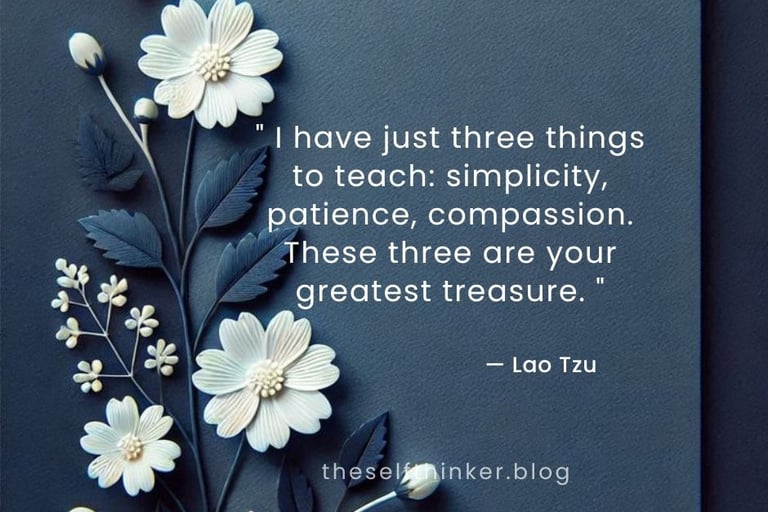
" I have just three things to teach: simplicity, patience, compassion. These three are your greatest treasures."
" When people see some things as beautiful, other things become ugly. When people see some things as good, other things become bad."
" He who controls others may be powerful, but he who has mastered himself is mightier still."
" Health is the greatest possession. Contentment is the greatest treasure. Confidence is the greatest friend."
" Great act are made up of small deeds."
" New beginnings are often disguised as painful endings."
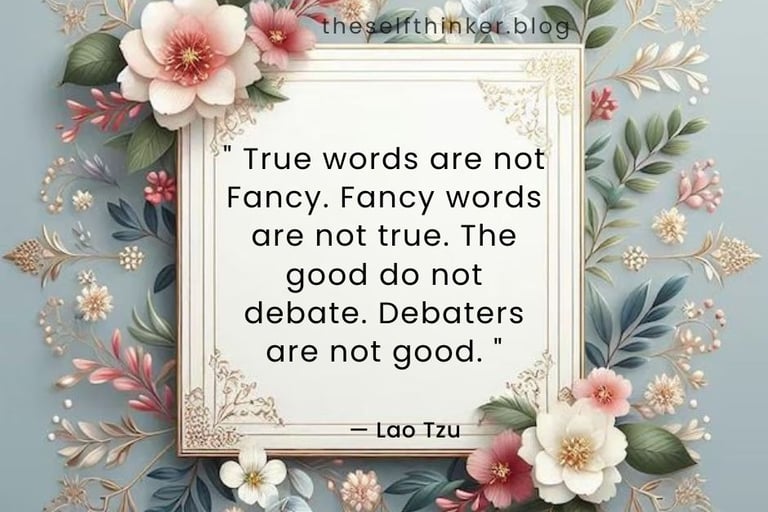
" True words are not fancy. Fancy words are not true. The good do not debate. Debaters are not good."
" Ordinary men hate solitude. But the master makes use of it, embracing his aloneness, realizing he is one with the whole universe."
" Without opening your door, you can open your heart to the world. Without looking out your window, you can see the essence of the Tao."
" Do the difficult things while they are easy and do the great things while they are small. "
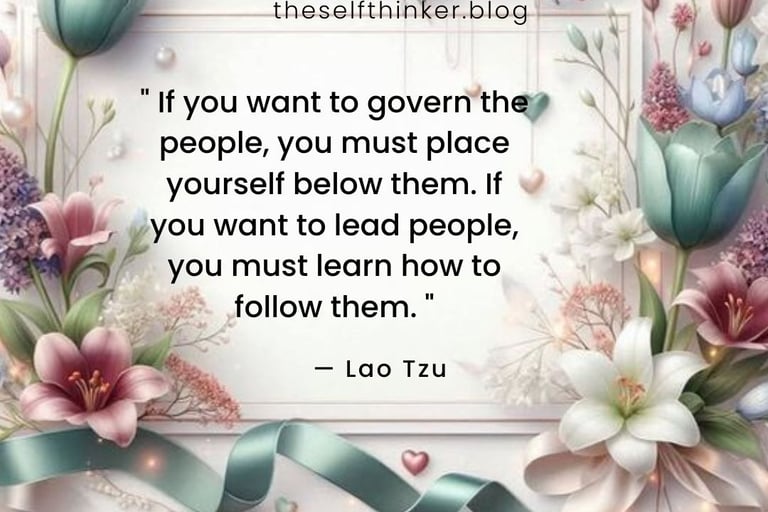
" If you want to govern the people, you must place yourself below them. If you want to lead people, you must learn how to follow them."
" Treat those who are good with goodness, and also treat those who are not good with goodness. Thus goodness is attained. Be honest to those who are honest, and be also honest to those who are not honest. Thus honesty is attained."
" The best of all leaders is the one who helps people so that eventually they don't need him."
" The Tao that can be trodden is not the enduring and unchanging Tao. The name that can be named is not the enduring and unchanging name."
" ( Conceived of as ) having no name, it is the Originator of heaven and earth; ( Conceived of as ) having a name, it is the mother of all things."
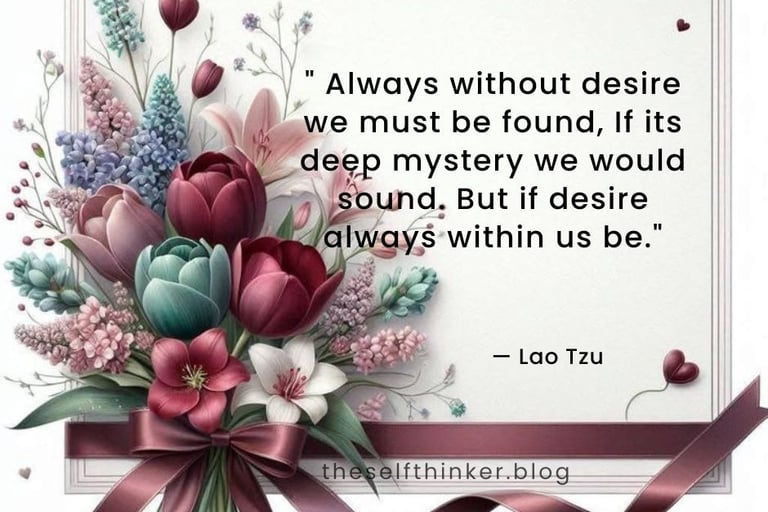
" Always without desire we must be found, If its deep mystery we would sound. But if desire always within us be."
Conclusion
Incorporating Lao Tzu's wisdom into our daily lives empowers us to lead more fulfilled and balanced existences. His famous quotes provide guiding principles that urge us to embrace simplicity, foster harmonious relationships, and practice patience. As we navigate our modern lives, let us take a moment to reflect on these timeless lessons from Lao Tzu and apply them in our pursuit of happiness and peace. The teachings of this ancient philosopher remain relevant, offering invaluable insights into living a truly meaningful life.